Omnia XII

Built for stations that demand control, musicality and on-air presence, Omnia XII combines advanced processing and intelligent tools to deliver a more impactful, balanced and competitive sound.

Omnia XII Front Transparent2

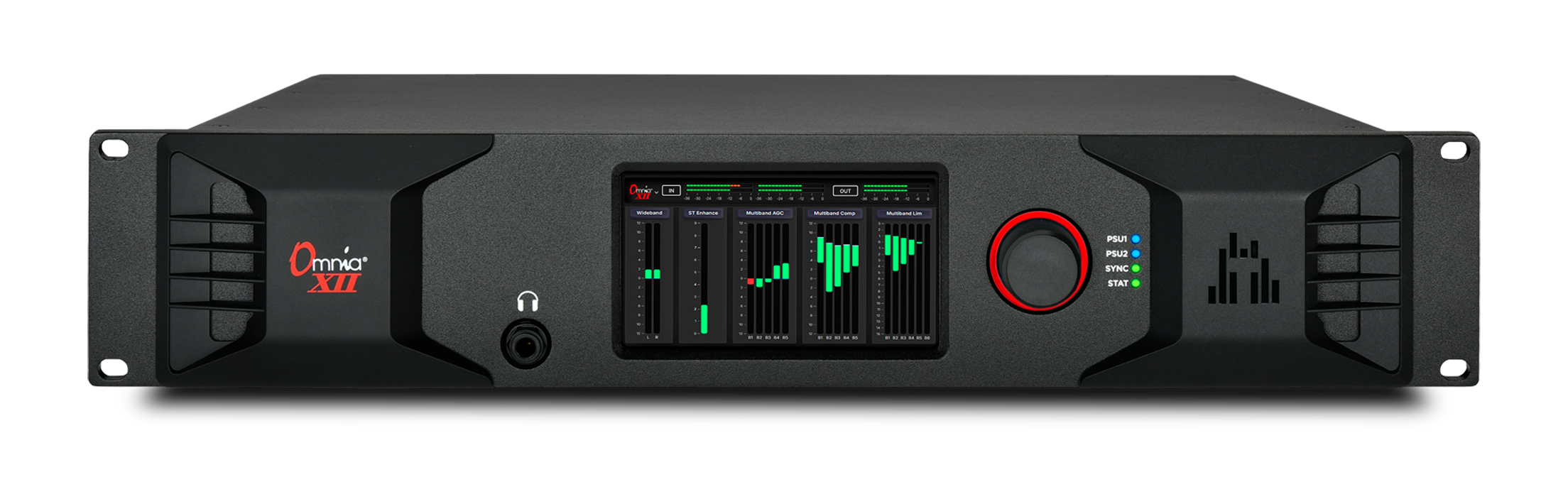
Omnia XII is Telos Alliance’s new flagship Broadcast audio processor, designed to help radio stations stand out with stronger, cleaner and more engaging sound. Built on a completely new architecture and equipped with advanced processing tools, it gives broadcasters greater control over their on-air sonic signature. The result is more consistent audio with presence, clarity and impact, helping reinforce the station’s identity and improve the listening experience. Whether for music, news, sports or talk radio, Omnia XII was created to turn technical performance into a real connection with the audience. It is a solution built for broadcasters that want to raise the quality of their on-air sound and stand out in an increasingly competitive market.


Main features

Completely new processing architecture

Omnia XII features a completely new generation of AGC, compressors, limiters, dynamic EQ and advanced bass management tools for greater control over the final on-air sound.

Clemenza final clipper

It includes the new clipper developed by Frank Foti, created to deliver more loudness and control without adding aggressive distortion or listener fatigue.

Fast adjustment with Omnia QuickTweak

QuickTweak tools allow multiple related parameters to be adjusted simultaneously, speeding up processing fine-tuning and simplifying technical work.

Connectivity ready for different workflows

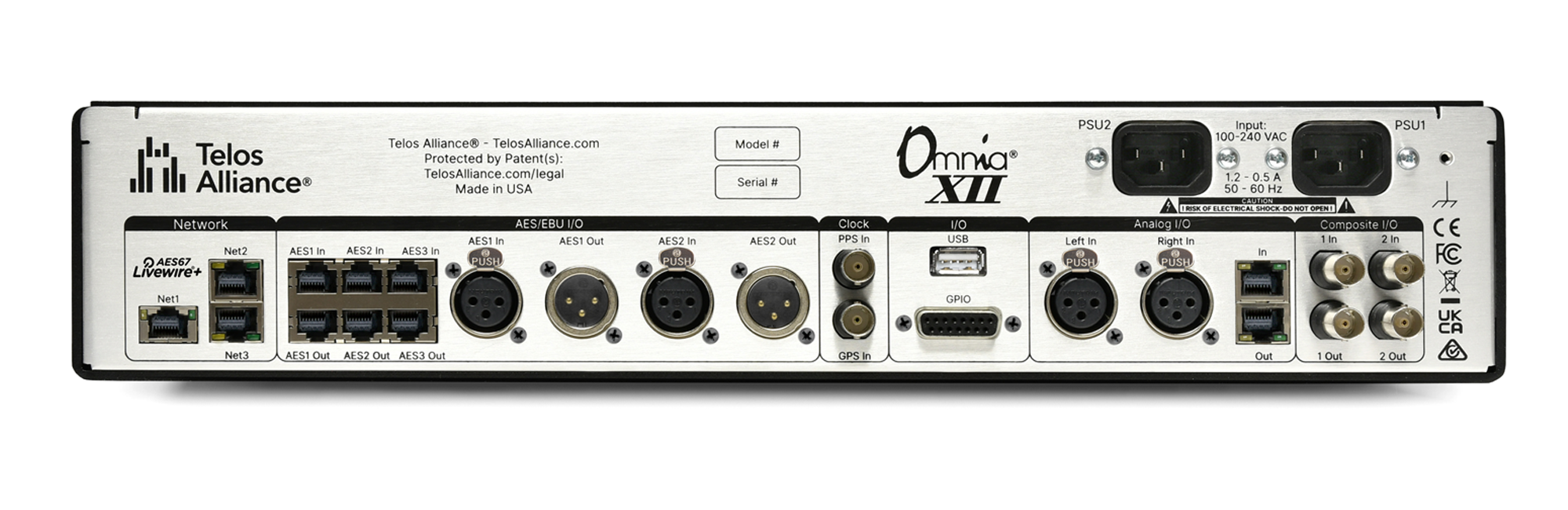
The processor provides analog, AES3 and composite I/O, as well as support for Livewire+ AES67, linear MPX over IP and optional µMPX encoding.

Integrated resilience and redundancy

Omnia XII includes redundant power supplies, relay bypass, automatic failover, backup audio playback and an architecture designed for continuous operation with greater reliability.

Omnia+XII Rear Carousel (1)
Omnia XII Front Transparent2

Main benefits

Stronger, cleaner and more engaging sound

Helps create a more distinctive sonic signature, with presence, clarity and musicality, capable of enhancing the broadcast and reinforcing the station’s identity.

More on-air impact without compromising listening comfort

The combination of the new processing and the Clemenza clipper makes it possible to increase sonic impact while maintaining a more natural result that is less fatiguing for the audience.

Greater flexibility in shaping the station’s sonic signature

It offers the freedom to build a more open and natural sound or a denser and more aggressive one, depending on the station’s positioning and format.

Faster fine-tuning and more efficient operation

It makes the work of technical teams easier by reducing the time needed to reach the desired result, without sacrificing detailed control.

A more future-ready investment

With a significantly more powerful CPU and a modular architecture, Omnia XII was designed to accommodate improvements, new features and emerging workflows without requiring immediate hardware replacement.

When the goal is to sound different, the technology must be different too

With a completely new processing architecture, the Clemenza clipper and the QuickTweak system, Omnia XII was created to give radio stations a stronger, cleaner and more distinctive sound, with real control over their on-air sonic signature.


Telos Alliance | Technical Specifications
Omnia XII
FM / HD / DAB AES67 SMPTE ST2110-30 MPX over IP 2U
Analog audio input
Analog line input and A/D conversion specifications.
Configuration Left/Right stereo, electronically balanced, mirrored on XLR or RJ45 connectors.
Input impedance 48k ohms resistive.
Maximum input level +24 dBu (0dBFS).
Nominal input level +4 dBu, resulting in a -18 dBFS input meter reading on a steady-state signal.
Dynamic range 110 dB ref. 0 dBFS.
Frequency response ±0.25 dB, 20 Hz to 20 kHz.
THD+Noise <0.005% @ 1 kHz, unweighted, -6 dBFS.
A/D conversion 24-bit, 128x oversampled delta-sigma converter with linear-phase anti-aliasing filter. Pre-ADC anti-alias filter and high-pass filter at <10 Hz.
Analog audio output
Analog line output, D/A conversion, frequency response and latency specifications.
Configuration Left/Right stereo, electronically balanced on RJ45 connector.
Output impedance <50 ohms.
Minimum load 600 ohms.
Output level Adjustable from -2 dBu to +24 dBu peak in 0.1 dB steps.
Frequency response ±0.25 dB, 20 Hz to 20 kHz.
THD+Noise <0.005% @ 1 kHz, unweighted, -6 dBFS.
D/A conversion 24-bit, 128x oversampled, 95 dB dynamic range ref. 0 dBFS, no spurious tones greater than 10 dB below noise floor.
Pre-emphasis curve Complies with the standard 50 or 75 microsecond pre-emphasis curve within ±0.5 dB, 30 Hz to 15 kHz. Analog L/R and AES/EBU digital outputs can be configured for flat or pre-emphasized output.
System latency 36 to 50 ms, depending on processing and clipper selection through the “FM” channel, measured from the analog inputs through the composite MPX output.
Digital audio input
AES input specifications.
AES 1 & 2 Relay Bypass equipped, EMI-suppressed XLR-F, mirrored with RJ45 connectors.
AES 3 RJ45 connector.
Source impedance Standard 110 ohms.
Status bits Follow AES-3 standard.
Resolution and selection 24-bit resolution, software selection of stereo, mono from left, mono from right, or mono from sum.
Signal compatibility Automatically accepts and locks to valid 44.1 / 48 kHz AES-3 signals.
Digital audio output
AES output specifications.
AES 1 & 2 Relay Bypass equipped, EMI-suppressed XLR-M, mirrored with RJ45 connectors.
AES 3 RJ45 connector.
Source impedance Standard 110 ohms.
Status bits Follow AES-3 standard.
AES cable length 100 meters using CAT6 or Belden 1800B.
Resolution and selection 24-bit resolution, software selection of stereo, mono from left, mono from right, or mono from sum.
Sample rates 192 kHz, 48 kHz, and 44.1 kHz, with support for Omnia Direct MPX over AES on all ports.
Digital output level AES-3 standard for peak-to-peak 2-7v at 48 kHz and 192 kHz into a 110 ohm load. Software adjustable from -22.0 to 0.0 dBFS.
Performance >120 dB S/THD+N.
External synchronisation
Sample rate synchronisation Output sample rate can be synchronised to the signal present on the AES/EBU input, or to an AES3 signal applied to the Ext. Sync input connector.
PPS / GPS PPS and GPS inputs support pulse per second (10MHz) signals for high-precision synchronisation.
MPX Composite
Analog MPX/SCA input and output specifications.
Analog MPX/SCA inputs Converted to digital, allowing them to be mixed into the composite output to add sub-carriers or switched to select an alternative composite source.
Input connectors Relay Bypass equipped on MPX 1, BNC with EMI suppression.
Input level 10v P-P.
Input impedance Hi Z.
Input frequency response ±0.01 dB, phase ±2 degrees, 40 Hz to 53 kHz, after software correction.
Input S/N >85 dB ref. 10Vp-p, 20 Hz - 200 kHz measurement bandwidth.
Input distortion <0.01% THD, 20 Hz - 53 kHz.
Analog MPX outputs Relay Bypass equipped on MPX 1, BNC with EMI suppression.
MPX output impedance 5Ω.
MPX output level 10v P-P, with internal jumper for low-level 4V safety output.
Maximum cable length 100’ / 30M RG-58U.
Output frequency response ±0.01 dB, phase ±2 degrees, 40 Hz - 53 kHz, >-1 dB at 2 Hz, >-10 dB at 76 kHz, after software correction.
Output S/N >85 dB ref. 10Vp-p, 20 Hz - 200 kHz measurement bandwidth.
Output distortion <0.01% THD, 20 Hz - 53 kHz.
Reference output 19 kHz reference output available on either MPX output 1 or 2.
MPX performance
Pilot stability 19 kHz, ±0.5 Hz.
Pilot S/N -85 dB typical, 75 µSec de-emphasized across 15 kHz, at 100% modulation.
Pilot distortion <0.02% THD, 20 Hz - 15 kHz, 75 µSec de-emphasized @ 100%.
Pilot adjustment Adjustable from 4.0% to 12.0% in 0.1% steps and OFF.
Stereo separation >55 dB, 40 Hz - 15 kHz.
Linear crosstalk >-80 dB, main-to-sub or sub-to-main @ 100%.
Non-linear crosstalk >-80 dB, main to sub or sub to main @ 100%.
38 kHz suppression >70 dB @ 100%.
76 kHz suppression >80 dB @ 100%.
Pilot protection >-60 dB relative to 9% pilot injection, ±1 kHz.
57 kHz protection >-50 dB for RDS/RBDS.
Remote control, GPI and power
Remote control HTML5 browser-based GUI.
GPI interface Fully configurable Livewire GPIO.
GPI connector DB-15 with EMI suppression, opto-isolated, using 5 in / 5 out xNode wiring standard.
GPI power Includes +5v, 100mA power with internal self-resetting thermal circuit breaker. EMI-suppressed DB-15 female connector.
Power supplies Dual internal, with overvoltage and short-circuit protection.
Voltage and frequency 100-250 VAC, 47-63 Hz.
Typical / maximum consumption Typical: 65W RMS, Max: 90W RMS.
Power connectors 2 EMI-suppressed IEC male connectors.
Maximum power consumption 76 watts.
Ethernet & AoIP
Network hardware 3 rear panel GigE ports supporting IEEE 1588, with status indicators associated with the jacks.
RJ-45 connectors EMI-suppressed RJ-45 connector with shielded jacks to chassis.
NICs Fully independent, capable of separate subnets, IPs and MAC addresses.
Livewire input Livestream, 1mSec and Standard Streams, stereo only.
Livewire output 1mSec and Standard Streams, stereo only.
AES67 Input/output: 1 mSec, stereo only.
MoIP Support for MPX over IP.
SMPTE SMPTE ST2110-30 Level A.
Regulatory compliance
United States Complies with FCC Part 15 Subpart B: 2023.
Canada Complies with standard ICES-003 Issue 7.
Europe Complies with European Union Directives 2014/30/EU, 2014/35/EU and 2011/65/EU+(EU) 2015/863.
United Kingdom BS EN 55032:2015, BS EN 55035:2017, BS EN 62368-1:2022 and BS EN 63000:2018.
Australia / New Zealand AS/NZS CISPR 32:2015+AMD1:2020 and AS/NZS 62368.1:2022.
Dimensions, weight and environment
Form factor 2U form factor.
Dimensions 19” x 16.9” x 3.4” (482 x 428 x 86 mm).
Weight 14.5 lbs (6.57 kg).
Operating temperature 0 to 50 degrees C.
Non-operating temperature –20 to 70 degrees C.

Download the Omnia XII brochure

Omnia XII Front Transparent2
Download the official brochure and discover the key features, architecture and integration options of Omnia XII for FM, HD Radio and DAB.